Wednesday, December 23, 2015

The Ringmaster’s Daughter

I would say it again… Jostein Gaarder is the master of storytelling! Not only that he crafted a puzzling frame story for this book, but he also “deceived” us on the title. The Ringmaster’s Daughter is NOT at all about the daughter of a circus owner—which for some years made me mistaking this book as a bit childish. It is far away from childish. The Ringmaster’s Daughter is about how traumatic childhood experience can hugely change someone’s life.

Petter “The Spider” was leaving a book expo in haste because he thought his life was in danger. So, we know that he is a bookish man, who has done something that makes other literary people from the expo wanting to kill him. After he arrived safely at a secluded hotel, he forced himself to write his story—as usual with Gaarder: story within story.

Little Petter lived with his mother—his dad has left the house—and he had a unique ability to create stories from…well…everything! His brain is hyperactive, and he couldn’t stop it from inventing plots of stories. Connecting that with the book expo, he should be an over-productive writer, right? But no, Petter doesn’t like to be famous, and he don’t have patience to write novels. He just created plots—a lot of them! Later when his mother died, and he was on his own, he founded Writers Aid, a corporation that helps writers around the world get brilliant plots for their next novels. Suddenly Norway—where The Spider lives—was flooded with new novels; not only that, literary world suddenly getting a booming; all because of this one man, the ghostwriter, Petter. Oh and he got rich from it. But then... as in all things that are built over falsity, the bubble is threatening to blow out.

From there I know there’s something wrong with Petter, but what? And what about the little man with green hat who at first dwells inside Petter’s head, but then becomes real although only Petter can see him? And of course there’s Panina Manina the ringmaster’s daughter who didn’t know his father until it’s too late, which seems to be Petter’s favorite story. Not until the end though, did I get the meaning of them all. Here’s a spoiler…. Petter turns out to have traumatic experience when he’s a kid. Right after that he likes to have those active thinking. It’s just his mechanism to shut his brain from remembering the traumatic thing. So I guess the little man with green hat is his consciousness. At first he’s just a boy with active imagination, and so the little man only appears inside his imagery world. But when he’s grown up and brings the imagery world into reality (Writer’s Aid), the little man too must do his job in the real world. Mystery solved!

As always, Gaarder crafted the story amazingly. I also loved the plots and stories created by Petter. Hey, it feels like reading Italo Calvino’s If a Traveler’s…. stories in a story! Two things that I just realized after reading this are: our existence in the universe (Gaarder taught philosophy for high school anyway), and his love of oranges. Yeah… I think I read about oranges in several of Gaarder’s books; he must love oranges very much! J

For all that…. Four stars for The Ringmaster’s Daughter.


Wednesday, December 9, 2015

My Life in Books: A Book Tag

Thanks to Melisa, I will have something to post in this blog, finally! If you are wondering why I have abandoned this blog since… early this year (X_X), I have explained all in this post. Hopefully this book tag will return my blogging spirit!

1. Find a book for each of your initials

I picked two of my favorites for this year.


Far from a Madding Crowd by Thomas Hardy


The Agony and the Ecstasy by Irving Stone


2. Count your age along your book shelf: What book is it?

Goodreads made it easier than counting along my actual book shelf; so here is the 44th book from my “own-shelf” shelf:


The Racketeer by John Grisham


3. Pick a book set in your city/state/country

There are not many Indonesian books in my wishlist, but one of them is:


Max Havelaar by Multatuli


4. Pick a book that represents a destination you would like to travel to

I love Paris too much to not wanting to travel there again….someday….


The Paris Wife by Paula McLain


5. Pick a book that is your favorite color

One of my favorite books in my favorite color: Red


The House of Mirth by Edith Wharton


6. Which book do you have the fondest memory of?

I don't know about this. Maybe I don't have one in particular, but this book has set me to be Zola's fan.


L'Assommoir by Emile Zola


7. Which book did you have the most difficulty reading?


Notes from Underground by Fyodor Dostoyevsky


8. Which book in your TBR pile will give you the biggest sense of achievement?

Couldn’t read this book this year, hopefully next year!


Bleak House by Charles Dickens


If you want to do it, you’re free to tag yourself! ;)


Tuesday, February 3, 2015

Vita Brevis: A Letter to Saint Augustine

In one of his trips in 1995, Jostein Gaarder accidentally found an old manuscript in a secondhand bookshop in Buenos Aires. It was a letter in Latin from a woman signed herself as Floria Aemilia, addressed to Aurelius Augustinus, Bishop of Hippo. Gaarder bought it, and after examining it, became strongly believed (although no authority could yet confirm) that it was being originally written by St. Augustine’s mistress, whose identity he has concealed in The Confessions, but Augustine did mentioned the woman as his mistress quite a lot. I read this book right after finishing The Confessions, in order to judge it more contextually. My copy (translated to Bahasa Indonesia) contains only 150 pages, yet it was a thought-provoking reading.

Floria was an intellectual woman; she met Augustine for the first time when they were both pupils in rhetoric school. And through her letter, she quoted a lot from great philosophers like Cicero or Horace. The main purpose of the letter was to criticize Augustine for abandoning her for God, and to question his thoughts in The Confessions which she happened to read, perhaps not long after it was published. For some people, Vita Brevis—the Latin words of ‘Life is Short’—was perhaps a touching love story of an abandoned woman, but I regarded it as a mere ungrounded jealousy of a woman who could not accept being defeated by a “philosophy”. She bitterly and desperately wanted to tell the world that Augustine was all wrong.

I felt sorry for Floria because, though she was intellectual, she was so selfish and narrow-minded that she could not see beyond herself. She kept accusing Monica (Augustine’s mother, the Saint) for breaking their relationship to make way to Augustine’s marriage with a young girl. Well, dear Floria, think about this, by whatever standard you valued yourself, you were just a mistress, never Augustine’s legal wife. So how could you claim your rights to own him? Any mother who is intimate with God would react the same as Monica to any woman who seduces her son to live in sin. Then you criticized Augustine’s struggles to purify himself by staying away from earthly beauty as blasphemy to God. It only proved your ignorance and narrow-mindedness. Why couldn’t you be happy that your beloved man was reaching towards his real call, which is God? Why couldn’t you just support what he was fighting for? If you loved him as much as you kept boasting, you should! Instead of asking the same question over and over again: “Do you remember how sweet our love was, Aurel?”

And in the attempt to pour your anger to your Aurel, perhaps, you have done just the same thing as you criticized Augustine for. You accused him of cutting the whole context of bible text: 1Cor. But in the attempt, you yourself cut the whole context of Augustine’s Confessions. It was only proof that you could not really understand the deeper meanings of Confessions. Well, for that I could not scold you, because this whole thing is just about two persons who have loved each other in the past, then one of them completely changed, while the other stayed the same. Thus there lied a wide gap that separated them, as wide as the gap between earthly and spiritually lives.

See? This book is for me more tiring than touching. I just can’t sympathize with women who think life is just about love, lust, and romance. It’s rather surprising, in Floria’s case, because she was a learned woman, and she was then even a catechumen. I can understand how hurt for her to be abandoned by the man she’d loved, but doesn’t it happen to many women? She criticized that God or the Catholic Church has acted injustice by hindering a man from loving a woman. But it does not apply to every man, only whom He calls, and Augustine was among them. And it’s not because men shouldn’t love women, if so, why then God created us as man and woman? It’s because, in this case, Augustine’s sexual passion over Floria has barred him from seeing the Light of God.

In the end, I was disappointed by this book. I have expected Floria as somehow in the same level with Augustine in theology and philosophy, as she has dared to answer the Bishop’s Confessions. Or at least, I have expected a bit about feminism. But in the end, it’s just about the rage of a woman over romances problem.

I guess two and a half stars are even too good for Floria, but at least it made me understand and appreciate The Confessions more than my original reading of it.

~~~~~~~~~~~

I read Indonesian translation by Jalasutra Publishing

This book is counted as:


Friday, January 30, 2015

Anna (Dunia Anna) by Jostein Gaarder

Jostein Gaarder, one of my favorite contemporary writers, is a remarkable storyteller. He could weave serious issues into an entertaining novel that it doesn’t feel like patronizing. Most (or all?) of his books are addressed to young readers, but adults can also enjoy his thoughts. Anna (translated to Bahasa Indonesia as Dunia Anna) is his latest novel, and it discusses about climate change and earth damage.

Anna would turn sixteen on 12 December 2012, and she gets an ancient ruby ring. For several nights, she has been dreaming about herself in the body of another girl of her age, even stays in the same house, named Nova. The difference is that Nova lives in 2082, when the face of our earth has completely changed. Temperature is going down, and many plants and animals are extinct, in consequence of human’s mismanagement of their nature. It turns out that Nova is Anna’s great-granddaughter, and now Nova is demanding her great-grandmother to restore the damaged earth to its early shape—that is before people from Anna’s generation spoiled it. And Anna sees it all in her dreams.

Now together with her boyfriend Jonas, Anna is going to work her best to prevent the earth damage. It is an almost impossible thing to do, but she apparently knows that the earth has gotten a second chance, and it’s up to her whether Nova her great-granddaughter must witness the damaged earth or can live happily as she is now.

As a young adult novel, Anna might be an engaging novel which entertaining as well as inspiring young people to act more responsibly towards their environment. But for adult readers, I think it lacks Sophie’s World or Maya’s deep reflection. It is in the story itself; it’s too short and a bit forced. When Anna needs a solution to save 1001 animals and plants, then voila!... Jonas produced it the day after, as he has just written it for school task. Too easy? And how about Aladdin’s magic ring which still had one request to be fulfilled, which is now belonged to Anna—the precious ruby ring? It’s a bit too childish, don’t you think?

But overall, Gaarder’s idea is good, and perhaps with this book, he wants to encourage young people to start thinking about earth problems; and that this big project is not impossible as long as we have courage and determination to start it. As is with his other books, Gaarder asks us to view outside ourselves; that we are part of a bigger existence, and we have equal responsibility to protect what God has trusted in our management.

Three and a half stars for Anna! And special thanks to my #secretsanta for giving me this.

Buat Santa: mampir ke sini ya...

~~~~~~~~~~~~

I read Indonesian translation from Mizan publishing group

This book is counted as:


#SecretSanta….Who Are You? (#BBI2014)


Sejak 28 Desember 2014 lalu ketika posting riddle dari Santa, aku hanya sempat beberapa kali saja mencoba menelusuri identitas Santa. Sayangnya akhir Desember hingga hari ini (dan sampai awal April nanti) aku luar biasa sibuk, sehingga meski sudah diberi clue oleh beberapa teman BBI, aku tetap tak bisa berpikir jernih dan menemukan identitas Santaku. Maaf ya Santa….. aku terpaksa nyerah deh! T_T. Mungkin ini jadi pelajaran buat tahun depan, seharusnya aku gak perlu ikut event ini lagi, karena tahun depan rasanya sih bakal sama sibuknya kayak tahun ini.

Sebelum liburan, aku sempat punya beberapa ‘tertuduh’ dari riddle Santa yang panjaaang ini. Tapi mereka adalah member BBI lama yang aku sudah kenal, dan masing-masing tidak dapat memenuhi semua kriteria di riddle itu (menurut penelusuranku sih…). Jadi kemungkinan besar Santaku yang baik hati memberiku 2 hadiah ini adalah member BBI angkatan baru, benarkah Santa? :D

Jadi….karena terbukti aku tidak layak sama sekali buat melamar menjadi asistennya Cormoran Strike #eh, maka beribu maaf buat Santaku, kalo aku gagal menemukan identitasmu, hiks… Semoga kau cukup terhibur bahwa aku senang banget mendapat Dunia Anna yang jadi incaranku, dan berhasil kubaca dan kureview. Terima kasih banget sudah memberiku 2 buku ya, Santa! Buka dong topengmu…. :P


Friday, January 16, 2015

Lucky No. 15 Reading Challenge


I know I know!….I should have stopped signing up to more reading challenges (I have entered 5, although my first intention was only 3, and it’s not included my own challenge!). But this one is irresistible! Astrid is hosting it for second round (I have missed the first one), so I think I would try my luck this year! (and 15 is my birth date... :D).

This challenge will require you to read 15 books (or more) from 15 categories below:

Chunky Brick: Grab that book with more than 500 pages that you’d always been afraid to tackle. You know you can do it!
My pick: The Blind Assassin by Margaret Atwood (637 pages)

Something New: Just purchased a book lately? Don’t let it buried in your stacks, read it now!
My pick: The Dreyfus Affair: J’Accuse and Other Writings by Émile Zola

Something Borrowed: Read a book that you borrowed from someone else. Don’t make the owner waiting forever for you to finish it. (Books borrowed from friends, libraries, or even rental places, are allowed)
My pick: One Flew Over The Cuckoo’s Nest by Ken Kessey (will borrow from Melisa)

It’s Been There Forever: Dig your TBR pile and read a book that has been there more than a year. It’s time for you to appreciate it :)
My pick: True History of the Kelly Gang by Peter Carey

Freebies Time: What’s the LAST free book you’ve got? Whether it’s from giveaway, a birthday gift or a surprise from someone special, don’t hold back any longer. Open the book and start reading it now :D
My pick: Dunia Anna (Anna) by Jostein Gaarder (it’s a gift from my secret Santa—whom I have not uncovered the identity yet! :P)

Bargain All The Way: Ever buying a book because it’s so cheap you don’t really care about the content? Now it’s time to open the book and find out whether it’s really worth your cents.
My pick: Vita Brevis by Jostein Gaarder (I never buy books without being certain I would like to read the content, but this book was really cheap—about $1.5 perhaps—and hopefully the content worth more than ithe price.)

Favorite Color: Pick a book from your shelf which has your favorite color for its cover! Is it pink, red or black? You decide.
My pick: Empress by Shan Sa (Red is my favorite color, and I love this book's wine-red color)

First Initial: Read a book that has been written by an author whose first initial is the same with you (Example: My name is Astrid, and I can read anything written by Agatha Christie, Aesop, Arthur Conan Doyle, etc)
My pick: Crime and Punishment by Fyodor Dostoyevsky

Super Series: Read one (or more!) books that belong in a series, it can be trilogy, or tetralogy, or anything.
My pick: The Moor by Laurie R. King (#4 of Mary Russell-Sherlock Holmes series)

Opposites Attract: Read a book that’s been written by a writer whose gender is different from your own.
My pick: The Walden by Henry David Thoreau (this is the easiest category so far!)

Randomly Picked: Ask someone else (a friend, your spouse, even your kids!) to randomly pick a book from your TBR pile. Don’t complain whatever they choose for you, just read it :)
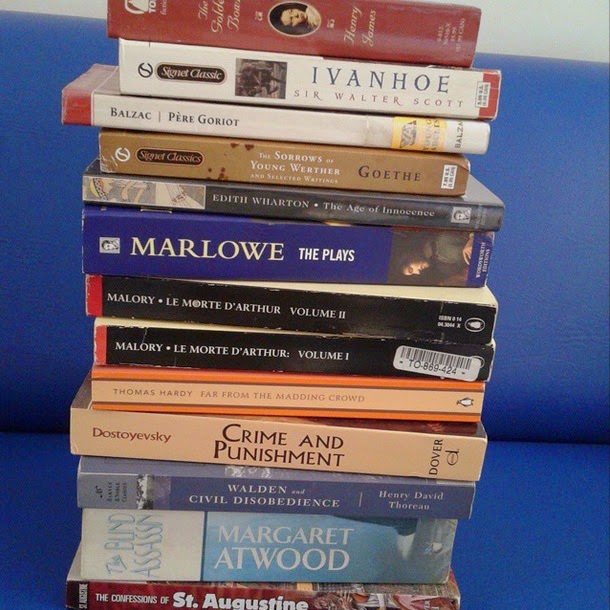
My pick: The Golden Bowl by Henry James (I asked Mr. Random to pick it for me from this pic—bottom to top, and he picked no. 12, which is on the top :D)


Cover Lust: Grab a book from your shelf that you bought because you fell in love with the cover. Is the content as good as the cover?
My pick: Far From A Madding Crowd by Thomas Hardy

Who Are You Again?: You’ve never read a book from this author, maybe you haven’t even heard his/her name before. But who knows? Maybe he/she will become your new favorite author!
My pick:  Pere Goriot by Honore de Balzac

One Word Only!: Read a book that only has one word for its title (number is allowed as long as it’s only consisted of one word, e.g: 1, 2, 11).
My pick: Ivanhoe by Sir Walter Scott

Dream Destination: Read a book that has setting in a place you’ve never visited before – but would like to if you have a chance. Could be real places or even fictional!
My pick:  Bleak House by Charles Dickens (because I’d really love to visit London if I had chance… someday… hopefully… ).

If you’re interested in joining, just visit Astrid’s blog.

Wednesday, January 14, 2015

A Letter of Mary: Mary Russell-Sherlock Holmes Series # 3

What would you think if you have lived in London in the 1920s, and heard news that the famous retired detective Sherlock Holmes has just married? ‘Awkward’ would be the first word pop up in my head. But interestingly, in A Letter of Mary, King has written it such that it seems normal—interesting but normal.

A female archeologist, Russell’s friend, visited the Holmes’ residence, and placed a small box containing an old papyrus under Russell’s care. It is believed to be a letter from the first century written by Mary Magdalene. Yep, it’s THE Mary Magdalene, the Saint. Few days later the Holmes found out that Ms. Ruskin has died in a hit-and-run accident in London. It turned out, of course, to be a murder. King develops several leads of suspects, including a sexist colonel who was disappointed that the archeologist he was about to sponsor was a woman; a Palestinian man who have visited Ruskin; and her nephew who would have had benefit from her death. Then a group of men ransacked Holmes and Russell’s house, and most probably wanted to get to the old papyrus. So Russell translated it (originally written in Hebrew), and found in it that Mary Magdalene has called herself the apostle of Jesus, which, if the letter was published in today’s world, would have huge impact, both historically and theologically.

[spoiler] Actually, the papyrus would have been an interesting point to dig on, and I have imagined some journeys to the east, tracing over historical facts, etc; but apparently King had another plan. In the end, it was just a usual lust-of-money kind of crime. [spoiler end] Again, there is the feminist theme all over the book (Mary Magdalene as Jesus’ apostle, Dorothy Ruskin the female archeologist among her male colleagues, and the misogyny Colonel and his son). However, concerning our detectives, King made Holmes won over Russell in solving this mystery. Maybe it was meant to be a balancing aspect against the feminism topic? And what about Russell’s feeling over the Colonel, considering his misogyny ideas? I think here in this story, Russell has fully grown up as a woman—she sees feminism not only as ideology, but the way a woman sees her opposite sex.

Speaking about feminism, one of the most interesting parts of this third book of Mary Russell-Holmes series is Russell-Holmes relationship—now as husband and wife. Russell said to Holmes that she thought they are not a romantic couple. But I disagree; I think they are romantic…in their own way. I think romantic isn’t about flowers, candle-lit dinner, etc. Romantic is when you know details about your partners; their habits, their likes and dislikes, their feelings and reaction over something; things you only share with your partners. And above all, they respect each other. Russell and Holmes are like this. I think the marriage life of two genius detectives with acute pride and high ego would be just like Russell and Holmes’s.

And sometimes there are indeed several ‘romantic’ scenes throughout the story. My favorite is when Holmes must leave Russell to her undercover at the Colonel’s house; and at the door before he left, he stopped, looked at Russell with unread expression, and said: “I feels like Abraham…”. This he refers to Abraham, when he took his family to Egypt, and told Sarah—his beautiful wife—to lie to Pharaoh that she was his sister, lest Pharaoh will kill him to take her as his wife. Isn’t it sweet? Or when Holmes confessed to Russell that now his heart controlled his mind (he was worried about Russell); to me that’s romantic—romantic in Sherlock Holmes style! :)

In short, this book might be my other favorite so far from the series, besides The Beekeeper Apprentice. Now, I can’t wait to read the fourth book, The Moor, which was set in Dartmoor, the setting of Doyle’s The Hound of the Baskervilles. Super interesting, eh? ;)

Four stars for A Letter of Mary, I liked and enjoyed the whole story. It’s been an oasis during the hectic month of December!


Sunday, December 28, 2014

Pamer Riddle dari #SecretSanta BBI 2014


Salah satu yang seru di akhir tahun (selain ngebut nyelesaiin reading challenge) adalah event yang rutin diadakan oleh BBI (Blogger Buku Indonesia): Secret Santa. Tahun ini, aku antara bahagia dan bingung setelah menerima kado dari Santaku. Bahagia karena dapat dua buku dari wishlist-ku, tapi bingung mecahin riddle-nya yang panjang dan serasa bertebar clue. Adakah yang bersedia membantu?.....

Ini dua kado yang kudapat dari Santa…


Thanks a lot for my very generous Santa!! Whoever you are, you’ve made my Christmas! ^_^

Dan ini riddle-nya. 


Kalau ada yang bisa memecahkan, tolong dong….kasih further clue aja paling tidak… *pasang muka melas*. Sudah ada beberapa “tersangka” sih, tapi belum ada yang memenuhi seluruh clue-nya, hanya cocok sebagian saja.

Semoga aku bisa menebak Santaku dengan benar di akhir event ini, sementara itu, aku siap-siap membaca Dunia Anna sepanjang liburanku dan mencoba melupakan misteri siapa santaku. Asyik! :)


Monday, November 24, 2014

The 2015 TBR Pile Challenge


This one challenge has proved to be one of the most useful tools in my reading life. As an organized reader, I usually created a reading list each year. Normally I would diligently follow it, but now and then there would be a new published book which is so enticing that I’d be tempted to kick out one or two books from the list to give place for the new comer. And this is why Adam’s TBR Pile Challenge has been very helpful. It helps me to keep on track. It would be hard to neglect a book that is listed in two challenges, as it means I would be failed in both, right?

So, I’m going to do this challenge again next year, and here is my list, complete with the publication date of my copies:

  • The Last Dickens – Matthew Pearl (2010)
  • True History of the Kelly Gang – Peter Carey (2006) – Ind. translation
  • The Bleak House – Charles Dickens (1994)
  • The Ringmaster’s Daughter – Jostein Gaarder (2006) – Ind. translation
  • The Confessions – St. Augustine Hyppo (2002)
  • Empress – Shan Sa (2012) – Ind. translation
  • Far from the Madding Crowd – Thomas Hardy (2012)
  • Crime and Punishment – Fyodor Dostoyevsky (2001)
  • The Fortune of Rougons – Emile Zola (2012)
  • The Agony and the Ecstasy – Irving Stone (1987)
  • The Blind Assassin – Margaret Atwood (2001)
  • The Golden Bowl – Henry James (2000)


Alternates:
  • The Call of the Wild – Jack London (1992)
  • Siddhartha – Herman Hesse (1999)


Will you participate too? Here’s the sign up page of Roof Beam Reader’s Official 2015 TBR Pile Challenge.


Tuesday, November 18, 2014

Wishlist Secret Santa 2014


Thanks to BBI, event Secret Santa kembali digelar tahun ini. Mungkin ini salah satu kegiatan BBI yang paling asyik bagiku. Di event Baca Bareng aku jarang bisa ikut karena biasanya aku sudah mengatur jadwal baca jauh-jauh hari, sedangkan BBI baru mengeluarkan daftar Baca Bareng belakangan. Jadi gak nyambung semua deh rencananya! :D

Tahun ini, alih-alih ‘mengisi rak di Goodreads’, kita diwajibkan memposting di blog, wishlist kita yang (semoga) akan dipenuhi salah satunya (semoga dua!) oleh Secret Santa kita masing-masing. Karena gak ingin mempersulit Santaku, aku hanya memasukkan 4 buku aja kok. *aslinya sih karena bacaanku kebanyakan English, dan buku-buku impor harganya mayoritas di atas harga maks :(

Ini dia daftarnya, diurutkan dari yang aku paling pengen… #kode


Dear my Santa, aku pengen banget dapat Dunia Anna, karena aku mengkoleksi karya-karya om Gaarder. Meski harganya dibawah batasan harga, gak pa pa kok…. Kalau mau ditambah yang urutan ke 2 boleh jugaa…. Apalagi kalau digabung sama yang no. 3…. *digetok Santa*

Semoga Santa mengabulkan keinginanku! ^__^


Tuesday, November 4, 2014

By The River Piedra I Sat Down and Wept

This might be the last book from Coelho which was still in my to-be-read pile. I have expected it to be good, as I have read many good reviews about it, and even my father recommended it to me. But it turned out to be a bit flat. It is the story of a Spanish young woman, Pilar, an independent woman who was searching for a greater life than hers at present, as a college student. One day a letter came from her childhood friend—on whom she had had a crush when they were at school—asking her to meet him. Eager to add sparks to her dull life, she decided to accept the invitation.

Pilar then learned that he has become a famous spiritual teacher who could perform curing miracles. He told her that he never stopped loving her; in fact he has entered a seminary, and now was in the middle of making an important decision, of to whom he should give his life for: the Church, or the woman he loved most. Pilar at first trusted her logical sense that he was just a childhood crush; that falling in love with him would ruin her perfectly-organized life. But this time her heart betrayed her sense, and she was soon falling in love with him. One only problem: he was going to be a priest; what must she do to keep him for herself?

While accompanying him for several days, Pilar—who had been cold towards God and her Catholic faith—started to learn his spiritual ideas about the feminine side of God. This part was where this book twisted to an unexpected theme, theology; and suddenly the atmosphere became slightly thicker. I am a conservative Catholic, and I am not sympathizing with Charismatic movement. Of course it is just my principle, and I can’t blame the author—any author—to have different branch of faith from mine; but in course of reading a book, this difference would make me uncomfortable, and it affects my whole view of the book. It cannot be justified, perhaps, but I just can’t help it.

On the last chapters, I just could not wait to finish this book. I just wanted to know, will he continue to become a priest or will he marry Pilar. After reading this, I feel that my taste is no longer with Coelho’s works, and I don’t think I would ever read his next books. His prose is still beautiful, but I believe it is me who has changed. Now I prefer books which are more down to earth; reflecting real life, and not just idea. With this book, I cannot relate my emotion or thoughts with the characters; they are too surreal and too far for me.

For all that, I granted three stars for By The River Piedra I Sat Down and Wept.

~~~~~~~~~

I read Indonesian translation, published by Gramedia Pustaka Utama

This book is counted as:


Wednesday, October 1, 2014

The Giver by Lois Lowry

Reading this dystopian book, reminded me of the lyric of a popular song, Imagine:

Imagine there's no countries
It isn't hard to do
Nothing to kill or die for
And no religion too
Imagine all the people
Living life in peace...

Imagine no possessions
I wonder if you can
No need for greed or hunger
A brotherhood of man
Imagine all the people
Sharing all the world...

In the song which was released in 1988, John Lennon was imagining a world entirely different from ours. He was presupposing that if we eliminate all painful and restrained elements from life, the world would be a better place to live in. In The Giver, Lois Lowry challenged its modern young readers to question themselves whether a dystopian world as John Lennon has—and perhaps many people have too—imagined would make us happier. So, she created the “Community” where our heroes live.

Community is set by eliminating worldly struggles and uncomfortable things in daily life. Women are exempt from painful laboring by giving the task to some appointed women; and a family can receive a new child from Community (they can ask for exchange if they are not satisfied with the current child!). Elderly are separated from the family—obviously to eliminate the inconveniences of treating them—and when they are too old, the Community will ‘release’ them. They are given medicines to eliminate pains; and a committee will monitor their daily activities to decide what profession are the best for them. And there are so many regulations for all their routines; every aspect of their lives are guarded and controlled, so that all they have to do is just living it comfortably, and finally leaving it quietly. To achieve this, the Community erases their memory of the past, and lets only one person to bear all the memories—including the pains—so that he can act as advisor. This person is called The Giver.

When Jonas becomes 12 he realizes that HE is chosen for the next Giver. For about a year he takes ‘training’ from the present Giver. It means that the Giver little by little transfers his memory to his successor. From the flashes of the memory, we came to understand that our world has once been torn by a terrible war. Jonas must get through pains and sufferings; something he never gets in the Community. However, he also gets beautiful things he has never felt before: warm love of family, beauty of colors, etc. In the end Jonas believes that, notwithstanding the pain and suffering, the former world is worth to live in, compared to the Community. This realization, plus the fact he has revealed about the ‘release’ he often heard of, sets his mind to set up a dangerous plan with the Giver.

People have been praising this book; I have heard a lot of positive reviews of it, and that’s why I decided to read a book from two genres—which usually does not meet my taste—dystopian and young adult. In the end, I liked this book, because it teaches us to accept life as a whole. Life has never been a series of happiness and comforts; it contains struggles and pains too. Without sorrows, we would never know the meaning of happiness; before feeling hungry, you would never realize the value of food. It is after the pain of laboring and raising child, after the struggle in living with your spouse, can you feel the warmth of love and family. Life—however wretched it is—is always worth living.

It is good of Lowry to promote philosophy of life to young adults; a reminder to respect life, and to appreciate the beauty of it. It’s pity that the last part ended too abruptly. I wished Lowry would have dug deeper than that. But considering this book as a YA, it is acceptable.

I can only grant four stars; it’s really good, but it’s not quite shaking my emotion (I think I have read too much Zola’s lately!).

~~~~~~~~~

I read Indonesian translation from Gramedia Pustaka Utama
(I did not put the original cover of the copy I read, as I was annoyed by its childish image—sorry, I just can’t bear it…)


Monday, September 8, 2014

[Puisi] Ekaristi by Mario F. Lawi

Ini mungkin pertama kalinya aku membaca buku kumpulan puisi. Yang membuatku tertarik adalah temanya; aku kurang suka puisi-puisi tentang cinta yang, yah…begitu-begitu saja. Sebaliknya, puisi-puisi karya Mario F. Lawi ini sangat berbobot [baca: membuatku berpikir keras secara logika maupun secara iman]. Ya, seperti nampak pada judulnya, puisi ini bernuansa biblis [(Sakramen) Ekaristi adalah salah satu sakramen yang ditetapkan oleh Yesus Kristus menurut Alkitab—wikipedia]. Ekaristi juga biasa disebut Perjamuan Kudus. Sebenarnya, tidak semua puisi di sini bernuansa biblis, karena Mario memasukkan juga unsur budaya Sabu, Nusa Tenggara, darimana Mario berasal. Sebagian bahkan terasa sangat hangat dan personal karena mengisahkan kehidupan ayah-ibu Lawi sendiri.

Total ada sekitar 68 puisi, sebagian panjang, sebagian hanya sependek dua sampai empat baris, semuanya dikemas apik ke dalam 90 halaman buku ini. Dari cover depannya pun, buku ini sudah terasa puitis sekaligus bernuansa ekaristi, dengan bintang cemerlang di langit berwarna biru malam. Ternyata bila cover depan bernuansa putih dibuka, barulah kau akan menemukan ‘harta’ yang sebenarnya, yaitu sebuah sibori [piala tempat hosti suci dalam Gereja Katolik] bertatahkan emas dan permata. Seolah-olah ingin mengatakan tidak semua orang dapat menemukan Kristus; hanya mereka yang mau menghampiri bintang itu dan mau dituntun olehnyalah yang lalu akan dibawa kepada harta yang sesungguhnya.

Ada banyak puisi yang menggugah dan indah, aku akan ulas beberapa yang menjadi favoritku. Puisi Nazarenus, 2 (bahasa Latin dari ‘orang Nazaret’?) ini adalah yang paling kusukai…

Nazarenus, 2

Membungkus tubuhnya dengan udara,
Ia pun berjalan ke Nazaret.

Wangi rerempah masih
Membayang di belakangnya.
Luka bermekaran di tubuhnya
Seperti roti yang dipecah-pecahkannya
Beberapa malam sebelum.

Dengan tangan yang koyak, ia usap guratan
Lapang meja kayu yang tak sempat diberi kaki
Karena ia lebih dahulu diburu kesunyian
Dan menyingkir ke Getsemani.

Ia menatap ke dalam bilik,
Melihat Maria yang tersedu
Sambil menutup wajah
Dengan telapak tangannya.

Ia pun menangis,
Sungguh sebagai manusia.


Biasanya, yang tak kusukai dari puisi adalah maknanya yang seringkali abstrak; kau harus berpikir keras untuk memahami apa yang sedang disampaikan penulisnya. Tapi tidak dengan puisi Nazarenus, 2 ini. Puisi ini menimbulkan kesan bak menonton adegan film. Aku langsung menangkap bahwa settingnya adalah beberapa saat setelah Yesus bangkit; dan Ia pun mengunjungi rumahNya di Nazaret. Ada rasa haru menyeruak saat ia mengusap meja buatannya yang belum sempat diselesaikannya, juga saat ia mengintip IbuNya yang sedang menangis sendirian di bilik. Puisi ini sangat menampakkan kemanusiawian Yesus. Kali ini kita diajak melihat peristiwa sengsara dan salib Yesus dari sisi manusiawi; Yesus yang tadinya tengah bekerja membuat sebuah meja, harus meninggalkannya begitu saja (belum sempat diberi kaki); dan ada kesedihan menyeruak di hatiNya (sebagai seorang anak) saat Ia harus menyaksikan IbuNya menangis sedih. Namun, ada juga makna yang lebih dalam. Meja yang ditinggalkan sebelum selesai digarap, seolah melambangkan ketaatan Yesus sepenuhnya pada Bapa, sehingga saat waktunya telah tiba, ia pun meninggalkan segala yang Ia cintai (sebagai manusia), untuk menunaikan tugasNya sebagai Putra Allah.

Puisi “Penunjuk Jalan” juga menjadi favoritku, karena endingnya yang menyisakan perasaan… apa ya? #jleb banget lah. Aku kutip paragraf terakhirnya (terlalu panjang kalau semuanya):

Penunjuk Jalan

(…) Sekelompok orang lalu datang dari Timur
Memintaku menunjukkan jalan yang dilalui bintang.
Kata mereka Tuhan akan lahir esok pagi.
Kutunjukkan mereka jalan setapak,
Yang dulu pernah dilalui angin
Menuntun ibu dan ayah untuk saling menemukan.
“Di ujung jalan itu ada padang,
Sebuah bukit tempat kawanan dombaku bermain
Juga tiga kayu palang yang masih meneteskan darah.”

Masih ada beberapa puisi lagi yang istimewa bagiku: Lembing Dosa, Delapan Catatan Kecil Adventus, Retina, Onytha, 3, dan masih banyak lagi. Ada banyak bagian yang tak kumengerti maksudnya, namun secara keseluruhan kumpulan puisi ini menawarkan keindahan dan keagungan.

Empat bintang untuk Ekaristi dan untuk Mario yang sudah mengajakku untuk berpuisi dan ber-Ekaristi. Jujur, selain Kitab Mazmur, aku belum pernah membaca puisi. Setelah ini mungkin aku akan mencoba lebih banyak mengapresiasi puisi, namun tetap aku memilih topik rohani.


Monday, September 1, 2014

Tinker Tailor Soldier Spy by John le Carré

During the Cold War—when Sovyet was building its influence in the world—‘Control’ was the head of British intelligence called ‘Circus’. He suspected that there was a Sovyet’s mole (enemy’s secret agent who infiltrated intelligence) within the highest level of Circus. He secretly sent an agent to buy information from a defected Czech General, but Sovyet blew the operation, and the agent was shot on the back. The mole did exist!

About ten years later, an eccentric teacher, Jim Prideaux, arrived at a prep school in the suburban London. His body was military-built, and he liked to be alone. A student named Bill Roach maintained a close relationship with Prideaux, who praised him as a very good observer. One mysterious aspect which Bill observed from his new teacher, was that Mr. Prideaux often sent letters to himself and one of the teachers. He also saw Mr. Prideaux was maintaining a weapon which he hid underground his caravan.

Far away from the prep school, George Smiley—once a close assistant to Control, but was suddenly forced into retirement—got a surprise visit from an old friend. Peter Guillam, his ex-colleague in Circus brought him to a secret investigation of their old adversary: the secret mole—code name: Gerald, which must have been within the highest level of Circus. And so Smiley must take a thorough interview and patient investigation from his former friends and colleagues, whom he used to have personal relationship, and perhaps, even, whom he used to admire.

Tinker Tailor Soldier Spy turned out to be a great-genius spy thriller! I love how Carré opened the book with the school teacher Prideaux and Billy Roach; it made me wondering whether the spy things would happen in a small prep school. Billy Roach might not have any relation with the intelligence world, but his existence—and how he saw things through his eyes—built a solid difference between the real world and intelligence world, and it emphasized how smooth the spies work among us that we won’t suspecting anything. It makes you think, are people who are close to us all these times are really what they told us?

*spoiler alert*
One small problem with Tinker is how we must be groping in the dark for at least the first third of the book, before slowly beginning to understand what was happening. It is because Carré ‘played’ with mystery, and only after that lifted the veil little by little. But the final—and probably the second most important mystery—was not revealed until the end of the book. And we are left with big question mark: who murdered Haydon? When I came to think it over, maybe the biggest mystery is not the identity of the mole Gerald, but who has killed him; another enemy for Circus; another mole?

With puzzles on my mind, I tried to do small research on the internet; and found analysis which suggested that the murder was Jim Prideaux, to revenge the betrayal, and maybe, the people he was working with in Czech—whom were all killed. If that was true, then Carré has cleverly ended the book in an ironic-tragic-but genius way. It was ended just like it has been started, with Jim Prideaux and Bill Roach. It seemed so normal, but what about the gloomy atmosphere which Roach observed on his teacher’s face after his return from “his mother’s-funeral-absent”? Did it pointed out to his real feeling after murdering his best and closest friend? Oh, if that was true, then it became more tragic. And really, Bill might think he knew his teacher very well at the end, while actually there were much deeper and darker secrets in him. What do we really know about people’s untold secret? None…perhaps!

Four and a half stars for such a brilliant story!

~~~~~~~~~~

I read Sceptre mass-market paperback edition

This book is counted as:


Thursday, August 14, 2014

The Silkworm: Cormoran Strike #2

About one year after finishing The Cuckoo’s Calling, I was once again taken by Robert Galbraith to the office of C.B. Strike, the private detective. However, in contrast to the glittering show-biz aspect of a model’s murder in the first book, this time Galbraith took me to a grotesque macabre atmosphere of a writer’s mysterious death.

One day in his fatigue and lack-of-sleep condition, Cormoran has made a rush decision. He has dumped a rich potential but arrogant client to make way to a poor afflicted woman. Eleanor Quine asked his help to find his missing husband, a writer Owen Quine, and to bring him home. Quine was missing right after finishing his latest novel, which he boasted as his masterpiece: Bombyx Mori (the Latin words for ‘silkworm’). The manuscript has been spreading all over the town before Quine’s agent, Elizabeth Tassel, realized that many literary key people were pen-portrayed in this mythical-gothic thriller, including Tassel herself, an editor, a publisher, and Quine’s girlfriend (a writer); an element which stirred anger and, in some, fear in the literary world.

Several days later Cormoran found Quine’s death body in an empty house, tied, disemboweled, and putrid. The murder was performed theatrically, neatly, and cold heartedly, that the Police had no other lead to take than suspecting Leonora Quine of killing her own husband. If Cormoran, at the murder of Quine, might regarded that his job to locate the writer was done, now he took personal responsibility to save the unjustly accused wife from being wrongly convicted. This is what I love about Rowling aka Gailbraith. Her story is not just about crime and detective, there is also a touch of humanity. Cormoran’s decision might not always be wise or logical for a detective, but that is what made him distinguished: he has heart. This single aspect warmed Rowling’s detective story, which is usually cold.

Cormoran and Robin’s personal struggles are also interesting. Although I feel the excessive passages about Cormoran’s ex-fiancé is wasteful and boring; it is interesting though to see how both Cormoran and Robin—logical and intelligent as they are—picked the wrong partners for themselves. We can easily see that Charlotte and Matthew are selfish and narrow-minded people who could never understand Cormoran and Robin. But still, our detective and his assistant love them blindly. Well, maybe love is, sadly, blind indeed…. Particularly for Robin, I still don’t understand how a clever and sensible girl like her could have liked a guy like Matthew. Sometimes, girls can be so foolish when it comes to boys. *sigh*

Compared to The Cuckoo’s Calling, this one is less engaging. The idea is brilliant (but very ‘Rowling’, in her fondness of mythical elements), but it lacks the grotesque atmosphere around the murder. It feels more like a staged act than grotesque. I liked the idea of hiding parts of Cormoran’s actions when we were approaching the climax (and left us in the dark of what was actually happening), which was a bit like Agatha Christie’s; it made us groping and curious, which added the mystery. And I also liked how Cormoran’s and Robin’s relationship developed further; she proved herself capable of being Cormoran’s assistant. And of course, with Cormoran’s lack of physical fitness, their collaboration would be much more interesting in the next series. But apart from those aspects, the crime story itself is not prominent.

Three and a half stars for The Silkworm.